
Respect for Human Rights
While the global economy continues to develop, the challenges surrounding respect for human rights have also grown significantly.
Based on our Group Corporate Philosophy and Group Code of Conduct, our Group has strived to enhance corporate value by building strong relationships of trust with stakeholders through business activities that respect human rights.
To further advance our efforts regarding respect for human rights, we have established the "Hokuetsu Group Human Rights Policy." We support international norms such as the "International Bill of Human Rights," the "ILO Declaration on Fundamental Principles and Rights at Work*," the "UN Global Compact Principles," and the "Guiding Principles on Business and Human Rights."
Hokuetsu Group Human Rights Policy
The Hokuetsu Group acts in line with the Hokuetsu Group Human Rights Policy (this "Policy") to ensure that the human rights of all the people involved in our business activities are respected.
- Position
We have established this Policy based on the International Bill of Human Rights, the ILO Declaration on Fundamental Principles and Rights at Work, the United Nations Guiding Principles on Business and Human Rights and other relevant principles, and promote the initiatives for respecting human rights. - Scope of Application
This Policy applies to all the officers and employees of the Group. We expect all our business partners to understand and endorse this Policy. We work together with our business partners in promoting the initiatives for respecting human rights. - Compliance with Applicable Laws and Regulations
We comply with laws and regulations of the countries and regions in which we conduct business activities, and respect the standards of the United Nations and other international organizations to the fullest extent. - Human Rights Due Diligence
We have established a system for human rights due diligence including providing education and training, improving our workplace environment and systems, and managing our supply chain, in order to fulfill our responsibility for respecting human rights. We implement this system on an ongoing basis. - Remedies
We provide, or cooperate in providing, remedies if we are found to have caused or contributed to adverse impacts on human rights. - Responsibility and Structure
We have assigned a person responsible for implementing this Policy, who is in charge of supervising the compliance with this Policy and promoting initiatives for respecting human rights through our sustainability efforts and other similar activities. - Dialogue and Discussion
In promoting this Policy, we utilize human rights expertise from independent external experts and sincerely engage in discussions with our business partners. We also disclose our initiatives for respecting human rights through our website and other similar platforms.
Core labor standards include"prohibition of child labor,""prohibition of forced labor,""elimination of discrimination in employment and occupation," "recognition of freedom of association and the right to collective bargaining," and "safe and healthy working environments."
Promotion Framework
Our Group's human rights initiatives are undertaken as part of our sustainability activities, led by the Sustainability Promotion Division.
These initiatives are identified as a material issue within our sustainability activities.
We systematically implement human rights due diligence (HR DD) based on references such as the Ministry of Economy, Trade and Industry's "Practical Reference Materials for Respecting Human Rights in Responsible Supply Chains."
The Group has established the Group Sustainability Committee, attended by the Chairman and Group CEO, directors, and executive officers, as well as sustainability committees at each of our business sites and Group companies. This enables us to advance sustainability activities as a unified Group. Regarding human rights initiatives, the Group Sustainability Committee implements appropriate management for evaluation, prevention, and mitigation, while also reporting to the Board of Directors as necessary.
Human Rights Due Diligence
Overview of Human Rights Respect Initiatives
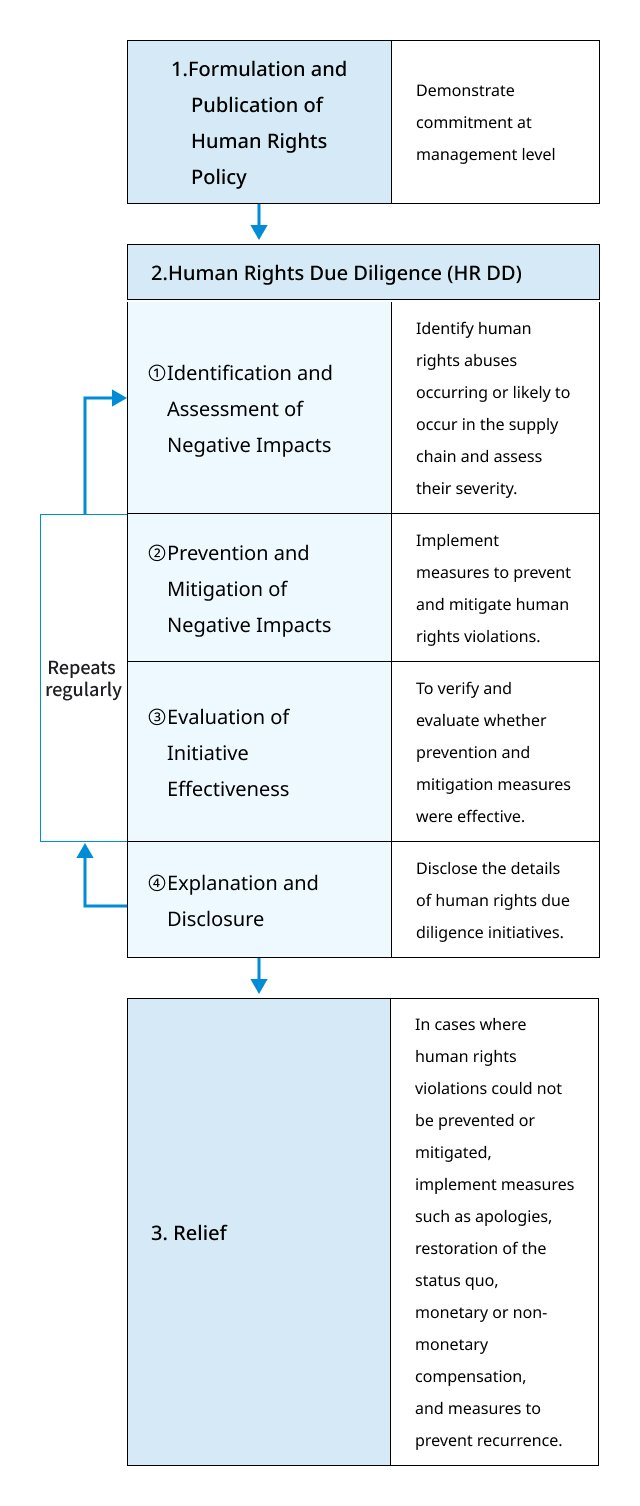
(Source)
Based on the Ministry of Economy, Trade and Industry's "Background and Overview of the Development of the 'Guidelines for Respecting Human Rights in Responsible Supply Chains, etc.'" with some additions by our company.
2024 Initiatives
Our group is advancing human rights due diligence (HR DD) with appropriate advice from external specialized institutions.
In fiscal year 2024, we identified and assessed adverse impacts by referring to the "Practical Reference Materials for Respecting Human Rights in Responsible Supply Chains" formulated by the Ministry of Economy, Trade and Industry.
Furthermore, utilizing the "CSR Self-Assessment Tool" developed by the Global Compact Network Japan, we conducted questionnaire surveys of our Group and primary suppliers, striving to identify the processes leading to adverse impacts (human rights violation risks).
(1)Identification of Significant Business Areas
・Business Areas: General Manufacturing (Paper Manufacturing), Forestry (Pulp Production)
・Product-Specific Human Rights Issues: Wood chips, etc.
・Regional Human Rights Issues: Vietnam (wood chips), etc.
(2)Identification of the Process Leading to Negative Impacts (Human Rights Violation Risks)
We conducted a survey targeting primary suppliers who purchase raw materials defined by our Group and our Company as product-specific human rights issues or region-specific human rights issues. This survey utilized the "CSR Self-Assessment Tool" developed by the Global Compact Network Japan.
◇Number of Surveyed Companies: 79
◇Responding Companies: 70 companies (Response Rate: 89%)
◇Trends in Response Content
・The survey content did not enable the identification of direct human rights violation risks.
・However, the responses revealed the following issues becoming apparent among some suppliers.
| No. | Assignment |
|---|---|
| 1 | Some suppliers lack guidelines regarding respect for human rights. |
| 2 | Some suppliers, no responsible person or department has been designated. |
| 3 | Some suppliers are not implementing initiatives to respect human rights. |
| 4 | Some suppliers lack rules (mechanisms) to address human rights issues. |
(3)Future Actions Based on the FindingsBased on the findings, our company will continue to advance initiatives respecting human rights. This includes planning measures to prevent and mitigate adverse impacts through awareness-raising activities, in accordance with our human rights due diligence (HR DD) process.
Regarding the Whistleblowing Hotline
In November 2025, our Group became a full member of the Japan Corporate Engagement and Remediation Center (JaCER), a general incorporated association that supports effective grievance mechanisms aligned with the UN Guiding Principles on Business and Human Rights.
The "Dialogue and Remedy Platform" provided by JaCER serves as a consultation and reporting channel for all matters related to human rights. It is available for use by our Group's business partners and other external stakeholders.
Through the utilization of this platform, our Group aims to establish and operate a fair and transparent grievance mechanism.
For inquiries regarding the Japan Center for Business and Human Rights (JaCER), please click here.